Armageddon Science by Brian Clegg
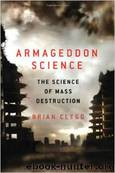
Author:Brian Clegg [Clegg, Brian]
Language: eng
Format: epub
Publisher: St. Martin's Press
Published: 2010-01-27T05:00:00+00:00
Chapter Six
Gray Goo
These microscopic organisms form an entire world composed of species, families and varieties whose history, which has barely begun to be written, is already fertile in prospects and findings of the highest importance.
—Louis Pasteur (1822–95), “Influence de M. Pasteur sur les progrès de la chirurgie,” Quoted by Charles-Emile Sedilliot, paper read to the Académie de Médecine (March 1878)
Pasteur’s words in the quote that opens this chapter refer to the “microscopic organisms” of nature. But imagine the construction of man-made creatures on an even smaller scale, an army of self-replicating robots, each invisible to the naked eye. Like bacteria, these “nanobots,” endlessly reproducing devices, could multiply unchecked, forming a gray slime that swamped the world and destroyed its resources.
Each tiny robot would eat up natural resources in competition with living things, and could reproduce at a furious rate. This sounds like science fiction. It is—it’s the premise of Michael Crichton’s thriller Prey. But the idea of working with constructs on this tiny scale, nanotechnology, is very real. It has a huge potential for applications everywhere from medicine to engineering, from sun-block to pottery glaze—but could also be one of the most dangerous technologies science could engage in, as the so-called gray goo scenario shows (gray goo because the nanobots are too small to be seen individually, and would collectively appear as a viscous gray liquid, flowing like a living thing).
Louis Pasteur and his contemporaries didn’t discover microorganisms. The Dutch scientist Antoni von Leeuwenhoek peered through a crude microscope (little more than a powerful magnifying glass on a stand) in 1674 and saw what he described as “animalcules”—tiny rods and blobs that were clearly alive, yet so small that they were invisible to the naked eye. This idea of a world of the invisible, detectable only with the aid of technology, was boosted into a central theme of physics as atomic theory came to the fore and it was accepted that there could be structures far smaller than those we observe in the everyday world.
The original concept of the atom dates all the way back to the ancient Greeks, though, if truth be told, it proved something of a failure back then. The dominant theory at the time was taught by the philosopher Empedocles, who believed that everything was made up of four “elements”: earth, air, fire, and water. It was the kind of science that seemed to work from a commonsense viewpoint. If you took a piece of wood, for instance, and burned it, the result was earthlike ashes, hot air, fire, and quite possibly some water, condensing from the air. And these four “elements” do match up well with the four best-known states of matter: earth for solid, water for liquid, air for gas, and fire for plasma, the state of matter present in stars and the hottest parts of flames.
This theory would be the accepted wisdom for around two thousand years. By comparison, the alternative idea, posed by the philosophers Democritus and his master, Leucippus, was generally considered more a philosophical nicety than any reflection of reality.
Download
This site does not store any files on its server. We only index and link to content provided by other sites. Please contact the content providers to delete copyright contents if any and email us, we'll remove relevant links or contents immediately.
The Art of Coaching by Elena Aguilar(53274)
Thinking, Fast and Slow by Kahneman Daniel(12318)
The Art of Thinking Clearly by Rolf Dobelli(10495)
The 5 Love Languages: The Secret to Love That Lasts by Gary Chapman(9820)
Mindhunter: Inside the FBI's Elite Serial Crime Unit by John E. Douglas & Mark Olshaker(9348)
When Breath Becomes Air by Paul Kalanithi(8451)
Periodization Training for Sports by Tudor Bompa(8278)
Becoming Supernatural by Dr. Joe Dispenza(8225)
Turbulence by E. J. Noyes(8057)
Bodyweight Strength Training by Jay Cardiello(7920)
Therapeutic Modalities for Musculoskeletal Injuries, 4E by Craig R. Denegar & Ethan Saliba & Susan Saliba(7723)
Nudge - Improving Decisions about Health, Wealth, and Happiness by Thaler Sunstein(7712)
The Road Less Traveled by M. Scott Peck(7606)
Mastermind: How to Think Like Sherlock Holmes by Maria Konnikova(7353)
Enlightenment Now: The Case for Reason, Science, Humanism, and Progress by Steven Pinker(7316)
Win Bigly by Scott Adams(7204)
Kaplan MCAT General Chemistry Review by Kaplan(6939)
Why We Sleep: Unlocking the Power of Sleep and Dreams by Matthew Walker(6729)
The Way of Zen by Alan W. Watts(6621)
